THE SHORT ANSWER
You can stop cigarettes on a chosen day and still use medication, coaching or both. CDC recommends counseling combined with medication because it gives people the best chance of quitting.
Separate the quit date from the support decision
“Cold turkey” often gets used for two ideas: stopping cigarettes all at once, and stopping without treatment or help. They are not the same decision. You can choose a clear quit day and arrive at it with nicotine replacement, a prescription plan, a quitline coach and prepared routines.
That distinction removes an unhelpful test of toughness. The useful question is which support makes your next attempt more workable. CDC recommends counseling and medication together, while recognizing both as effective treatments in their own right. CDC: how to quit smoking
“There are proven treatments to help people quit smoking.”
CDC, How to Quit Smoking
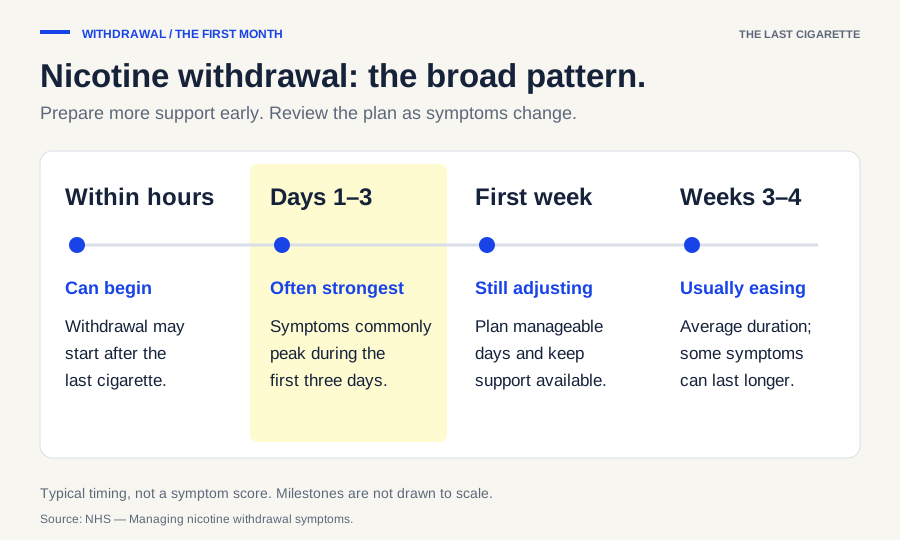
If you previously stopped without help and returned to smoking, you have information to use. Ask what brought you back: withdrawal, a social setting, stress, lack of preparation or several things together.
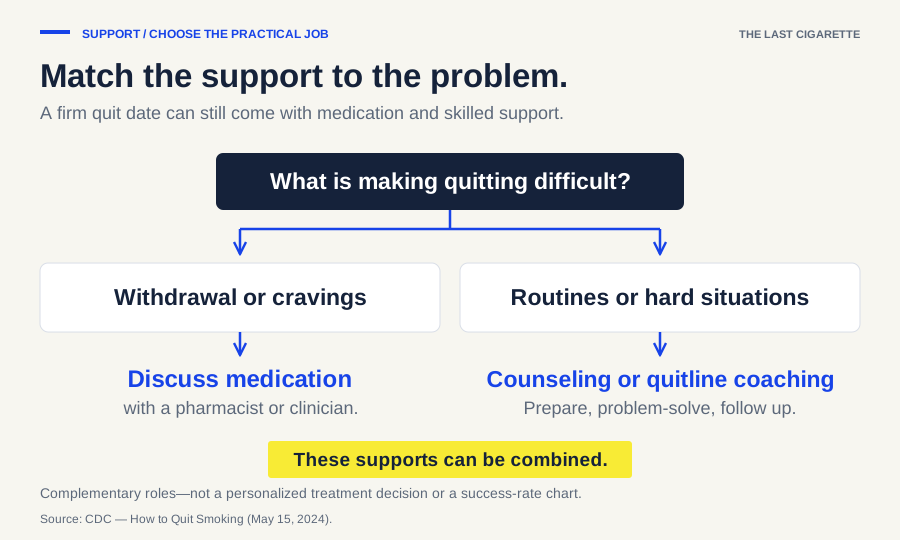
Choose support by the job it needs to do
| Option | What it can help with | Next step |
|---|---|---|
| Quit-smoking medication | Withdrawal and cravings | Discuss suitable choices and correct use |
| Quitline or counseling | A plan, problem-solving and ongoing support | Arrange a conversation before quit day |
| Personal plan and tracking | Remembering actions and spotting patterns | Write the three situations you expect |
| A trusted person | Practical company and specific check-ins | Ask for a concrete kind of help |
CDC describes counseling as help with preparing a plan and coping with urges and stress; medicine can help manage withdrawal. CDC: counseling and medicines
Our planning tools belong in the organization row. They can make a plan easier to return to, but they should not be described as equivalent to clinical treatment or as having the success rates of a studied medicine.
Understand the numbers without buying a promise
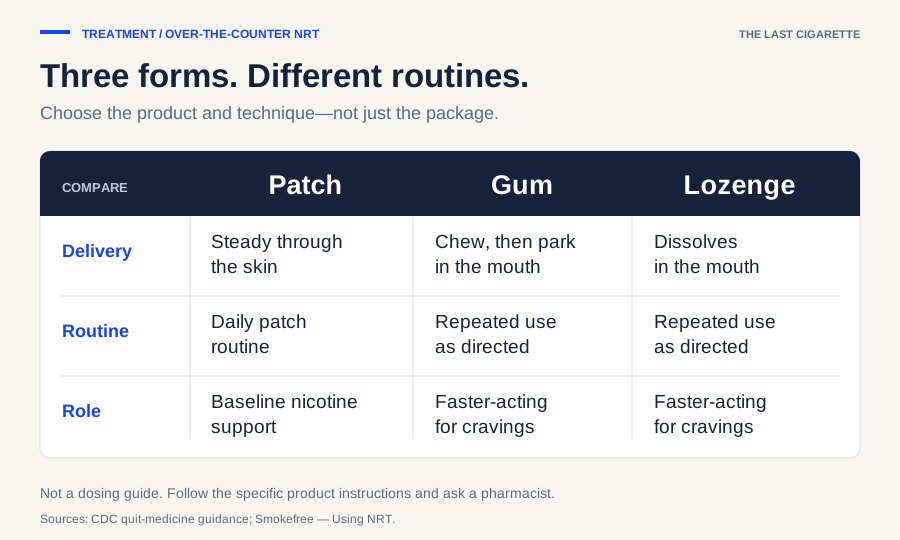
One well-supported choice is combining a nicotine patch with a faster-acting form such as gum or a lozenge. A Cochrane review published in 2023 found higher long-term quit rates than with a single NRT form: risk ratio 1.27, with a 95% confidence interval of 1.17 to 1.37, across 16 studies and 12,169 participants. Cochrane: combination NRT, 2023
A relative improvement is not a percentage-point increase. To illustrate the arithmetic only, if 10 out of 100 people quit with one treatment in a particular setting, a 1.27 ratio would correspond to about 13 out of 100 with the other. That example is not the review's universal quit rate.
Compare treatments using the actual comparison, the follow-up period and the population. “More likely to quit” does not mean every method has the same starting rate, and it does not tell you what will happen to one person.
If you prefer to try without medication
Make that a considered choice with a review point. Decide what you will do if withdrawal becomes the reason you are close to smoking. You can ask about treatment later; your first decision does not have to become a permanent rule.
Keep support available even if you decline medicine. You could arrange quitline coaching, tell a friend what help you need and write a response for each predictable trigger. “Without medication” does not have to mean doing everything privately.
A useful review question is: “Am I able to follow my plan through the difficult parts of the day?” If the answer keeps being no, change the support rather than repeating the same arrangement indefinitely.
Avoid measuring your attempt against someone who says they simply stopped one morning. Their story tells you little about your withdrawal, circumstances or available help. Choose the resources you can use consistently.
If cost is the barrier
Start with free support before assuming that quitting requires buying a program. CDC lists free, confidential quitline coaching through 1-800-QUIT-NOW, as well as online and text resources, and notes that some treatment may be free or covered by insurance. CDC: free support and coverage
Ask your insurer, state quitline or clinician what is available for your circumstances. Availability can differ, so ask for the actual cost and quantity rather than relying on a general advertisement.
If you budget for treatment, separate that temporary expense from the cigarette spending you hope to avoid. Our savings guide shows a clear way to do this. A useful tool should earn its place in your budget by helping you do something you need.
Prepare a better conversation
Before speaking to a pharmacist, clinician or coach, write down your usual cigarettes per day, when you smoke the first cigarette, what you have tried before and which situations caused trouble. Include current medicines and health circumstances when discussing treatment.
Bring a specific question: “The afternoon cravings brought me back last time. What could I use, and how should I use it?” That gives the conversation a concrete problem to solve.
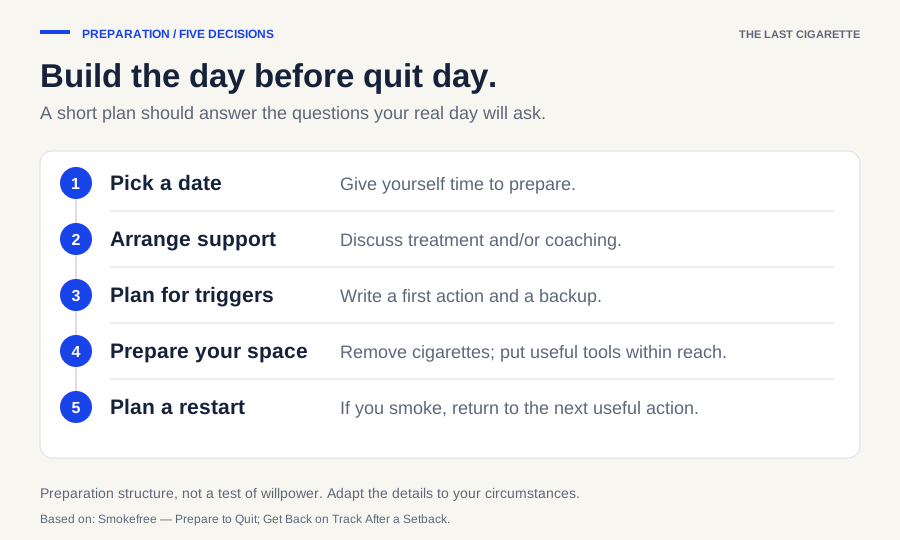
Then turn the recommendation into a day: obtain supplies, read instructions, choose your breaks and arrange a check-in. The quit-plan guide can help connect those decisions. The method matters, and so does making it available at the moment you need it.
Sources & editorial notes
Published October 28, 2026. Linked public guidance and research checked on that date. Written by The Last Cigarette. Practical scenarios, illustrations and planning prompts are our editorial examples. Source dates below identify research publication, not a promise that an individual will follow an average.