THE SHORT ANSWER
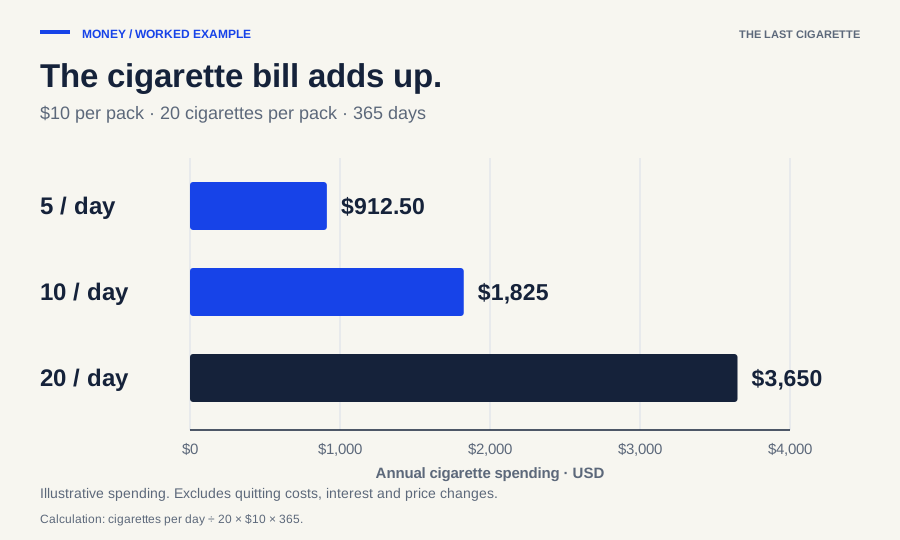
Daily cigarette spending equals cigarettes per day divided by cigarettes per pack, multiplied by pack price. At 10 cigarettes a day and $10 per 20-cigarette pack, that is $5 a day, $150 over 30 days and $1,825 over 365 days before quitting costs.
Start with your receipt
A national average is less useful than the price you pay. Take your usual pack price and pack size, then estimate a normal day's cigarettes. If weekdays and weekends differ, use a week's total divided by seven.
Do not count a pack as twenty cigarettes automatically if your actual product is different. Do not count the purchase price twice because you also record individual cigarettes. Choose one consistent method.
For ten cigarettes a day, twenty in a pack and a ten-dollar pack, the calculation is 10 ÷ 20 × $10 = $5 a day. Those are illustrative inputs, not a claim about the current average US price.
If you want to use your own numbers without doing the arithmetic by hand, try our free cigarette-cost calculator. Smokefree also provides a quit-smoking savings calculator.
Choose a time period and label it honestly
| Cigarettes a day | 7 days | 30 days | 365 days |
|---|---|---|---|
| 5 | $17.50 | $75 | $912.50 |
| 10 | $35 | $150 | $1,825 |
| 20 | $70 | $300 | $3,650 |
These are arithmetic scenarios with a fixed price and no cigarettes smoked during the period. They exclude treatment costs, other purchases, interest and future price changes.
Thirty days is not every calendar month. Twelve periods of thirty days total 360 days, not a year. For a simple annual figure, use 365 days and say so. For a specific calendar period, count the actual dates.
Keep future estimates separate from money already avoided. “Could avoid $1,825 over the next year” is different from “Have saved $1,825.” The first is a plan; the second requires a history.
Subtract the costs you actually choose
Quitting can have expenses: medication, transport to an appointment, a paid planning tool or another item you deliberately buy. Keep them visible rather than treating the gross cigarette total as cash already available.
Using the ten-cigarettes-a-day example, seven days avoids $35 of cigarette spending. If you spend $20 on a quitting-related item in that week, the net difference is $15. The next week will depend on that week's actual costs.
For another illustration, our complete program costs $49 USD once. At the example's $5 daily cigarette spending, that purchase equals 9.8 days of cigarette spending. This compares prices only; buying the program does not establish that you will stop smoking or generate a particular saving.
You can make a plan on paper and use free support. Choose a paid tool because you want what it contains, not because a calculator makes the purchase appear automatic.
Avoided spending is not the same as a savings balance
You can stop buying cigarettes and still finish the month with the same bank balance. The money may have paid for groceries, a bill or several small purchases. The cigarette expense was avoided, but the money did not necessarily stay untouched.
If you want a visible balance, decide where it will go. Transfer a realistic amount weekly, keep a separate budget category or reduce a specific debt payment by the amount you have redirected. Use a method that fits your finances.
On Sunday, check the cigarettes actually smoked and quitting costs paid. Calculate the week's net difference. Move only the amount your current budget can support.
Do not transfer an optimistic full-month estimate on day one if that would leave you short for essentials. A modest amount recorded honestly is more useful than a large number that exists only in a dashboard.
Make the goal specific enough to notice
Choose something the money can do: cover a bill, build a repair fund, buy equipment or pay for a weekend away. Name the amount and the next step. “Have more money” is difficult to recognize; “Put $100 toward the car repair” gives the plan a visible use.
Use two numbers: the goal balance you have actually set aside and the future amount you estimate you could redirect. Keep them separate. That prevents a forecast from quietly turning into an accomplishment.
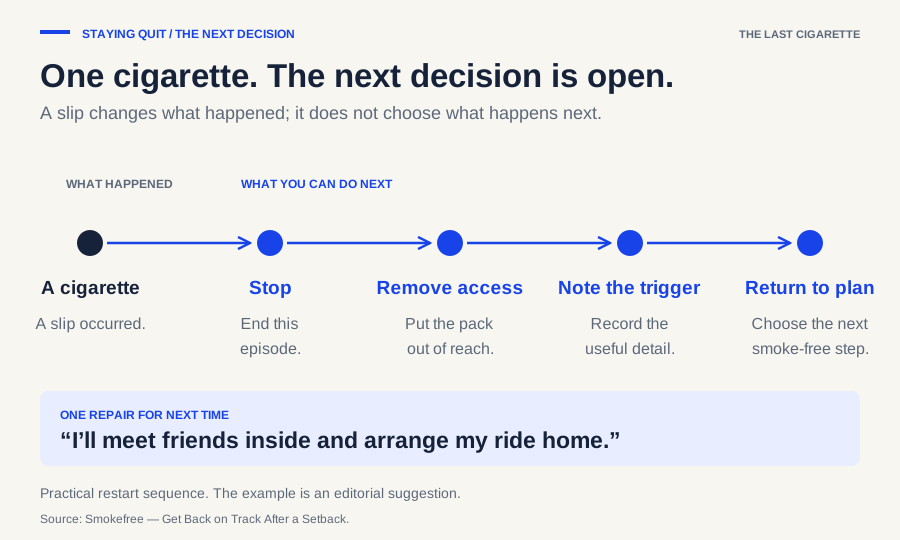
If you smoke during the period, record the purchase and continue the calculation. A slip changes the money total; it does not make the whole record worthless. Read the restart guide for the practical side of getting back to your plan.
Let the number support the next decision
A large annual total can catch your attention, but it will not tell you what to do after lunch. Pair your money goal with a response to the moment when you normally buy or smoke cigarettes.
You might take a different route home, keep the weekly transfer visible, or look at the goal before entering your usual cigarette shop. The point is to connect the arithmetic to a decision you will actually face.
Update the pack price when it changes. Keep past spending tied to the price you paid then rather than rewriting your history with today's price. That makes the record useful over time.
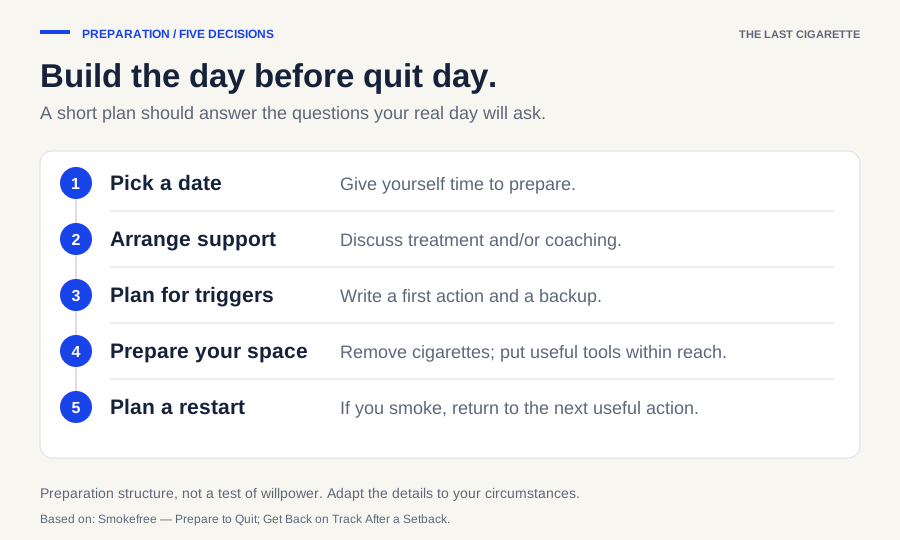
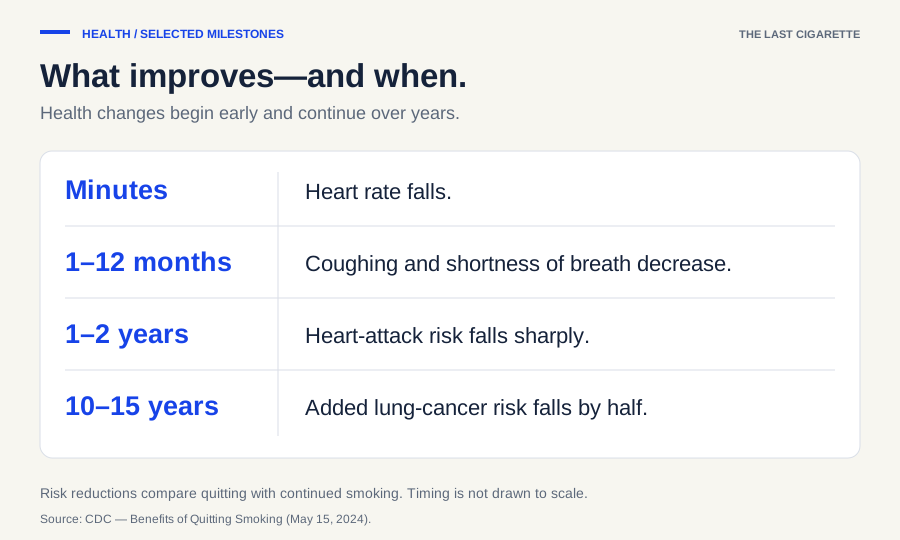
For a full first-week plan, use the quit-plan guide. For the longer health reasons alongside the money, see the benefits timeline. One gives you a budget, another a reason, and the daily plan gives you the next action.
Sources & editorial notes
Published October 28, 2026. Linked public guidance and research checked on that date. Written by The Last Cigarette. Practical scenarios, illustrations and planning prompts are our editorial examples. Source dates below identify research publication, not a promise that an individual will follow an average.