THE SHORT ANSWER
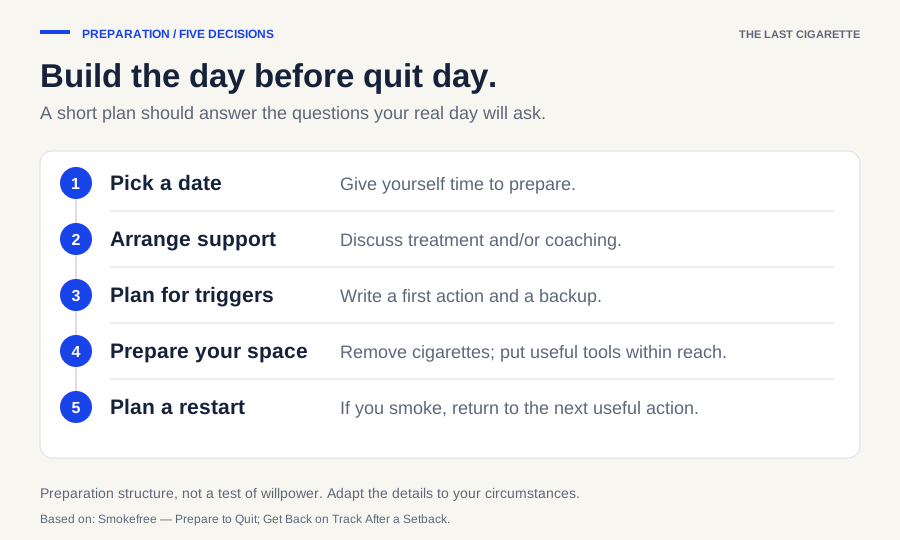
Choose a quit date, decide what support you will use, remove cigarettes and prepare specific responses to your main triggers. Keep the plan short enough to open during a difficult moment.
Start with the day, not a new personality
You do not need to become an unusually disciplined person before you can make a quit plan. You need to know what will happen when you wake up, take a break, finish a meal and feel stressed. A plan earns its place by answering those questions.
Smokefree recommends choosing a quit date no more than a week or two away, allowing time to prepare without putting the decision indefinitely in the future. It also recommends planning for withdrawal, identifying triggers and asking people for support. Smokefree: prepare to quit
If you already stopped, start from today. There is no preparation debt to repay. Write down the next day you need to get through and add the decisions that would make it easier.
A useful one-page plan has five parts: your date, your reason, your treatment or coaching arrangements, your three most likely triggers and your response if you smoke. The rest can be added when it becomes useful.
Make the support decision before quit day
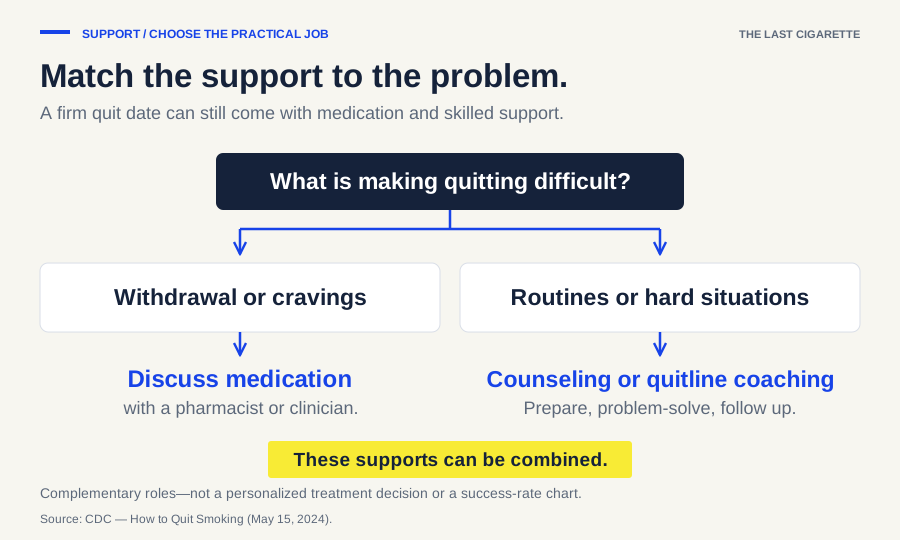
CDC recommends combining counseling and medication for the best chance of quitting. Options include nicotine replacement, prescription medicines and free quitline coaching. CDC: proven quitting support
You do not need to settle every medicine question from an article. Decide whom to ask and when. A pharmacist can explain over-the-counter products; a clinician can discuss prescription options and your medical circumstances. Put the conversation in your calendar and obtain supplies before quit day if you will use them.
Write the arrangement in ordinary language: “Call the quitline on Wednesday. Ask the pharmacist which product and instructions fit my smoking pattern.” That is a usable task. “Research all cessation methods” is an open-ended project that can keep postponing the start.
For a first comparison, see patches, gum and lozenges and quitting with support. A planning product can organize your actions, but it does not replace a medicine decision or a trained counselor.
Choose the three moments most likely to catch you
Smoking triggers can involve routines, people, emotions and places. Smokefree's trigger guide is a useful starting point, but your own day supplies the details. Smokefree: know your triggers
For one ordinary day, note when you smoke and what happens just before it. You do not need a long diary or an explanation of every cigarette. Look for the moments that repeat.
| Moment | First action | Backup |
|---|---|---|
| Morning coffee | Drink it at the kitchen table | Take breakfast outside without cigarettes |
| After lunch at work | Walk with a nonsmoking colleague | Call a friend while walking alone |
| Stressful evening | Take ten quiet minutes before chores | Ask my support person to check in |
Replace these examples with choices you can actually make. If you cannot leave your workplace, a walk is not a complete plan; choose something available in the building. If a support person is usually asleep, choose a different backup.
Prepare your surroundings for a tired version of you
Remove cigarettes, spare packs, lighters and ashtrays from the places where you usually reach for them. Decide what to do about the store on your route home. Ask people not to offer you cigarettes, including when you ask in a difficult moment.
Then prepare the replacement rather than leaving an empty space. Put water in the car, ordinary gum in your bag, or walking shoes beside the door. Keep any medicine safely stored and available according to its instructions. Set one reminder if it helps you follow a routine.
These changes should reduce effort. A plan that requires a long workout every time you want to smoke may collapse on a busy workday. A plan to step away, drink water and contact someone has a better chance of being available.
Tell your support person exactly what you want. “Can you check in after dinner for the first three nights?” gives them a clear job. “Make sure I never smoke” gives them responsibility they cannot realistically carry.
Plan the restart before you need it
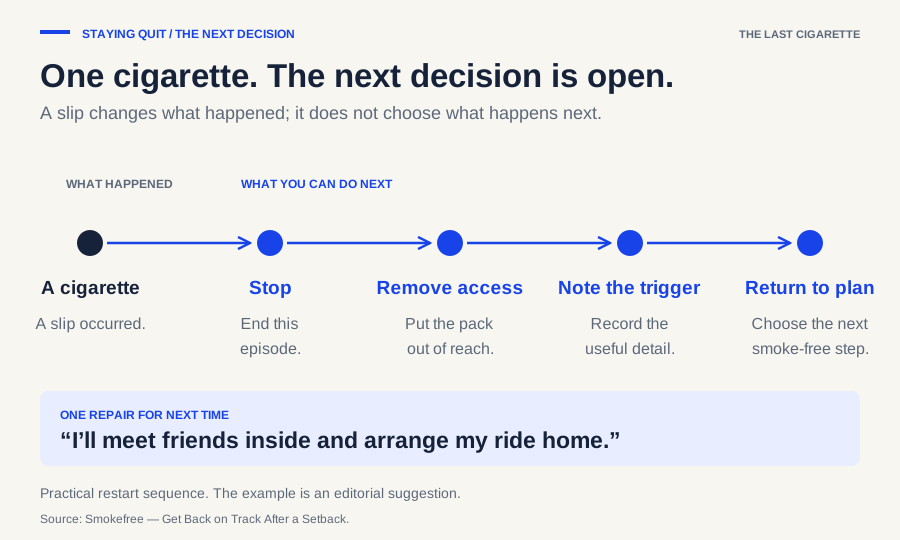
A contingency plan is not permission to smoke. It prevents one cigarette from deciding the rest of your week. Smokefree encourages learning from a slip and returning to quitting promptly. Smokefree: get back on track
Write three actions: stop the smoking episode, remove the remaining cigarettes and identify the situation that defeated your plan. Then change one thing before meeting that situation again.
For example: “If I smoke at the party, I will leave the smoking area, buy no more cigarettes tonight, and text my support person before going home.” The details are yours to choose. The essential point is that the next decision remains available.
Our guide to a smoking slip gives a more detailed restart process without turning it into an exercise in blame.
Review the plan after a real day
At the end of the first day, ask three questions: Which moment was hardest? What helped enough to repeat? What would make tomorrow easier? Change the plan using those answers.
Keep the review short. You are not trying to score your character or produce an impressive streak. You are deciding whether to buy a different breakfast, arrange an earlier check-in, take a different break or ask for more treatment support.
Choose a place the plan will live: a folded page, a phone note, a calendar or a personal dashboard. Use one main place so that a hard moment does not begin with searching through several apps.
Your first plan can be incomplete and still useful. If it gets you through a familiar trigger and tells you what to adjust tomorrow, it has done real work.
Sources & editorial notes
Published October 28, 2026. Linked public guidance and research checked on that date. Written by The Last Cigarette. Practical scenarios, illustrations and planning prompts are our editorial examples. Source dates below identify research publication, not a promise that an individual will follow an average.