THE SHORT ANSWER
Irritability and anxiety can be part of early withdrawal. The relief from a cigarette can include relief of nicotine withdrawal itself. Keep useful breaks in your day, prepare another response and get help for persistent or unmanageable mood symptoms.
Name the two problems separately
You can be under real pressure and experiencing nicotine withdrawal at the same time. A difficult customer, a sick child or an argument does not become imaginary because you stopped smoking. But nicotine can add another layer of discomfort to a day that was already demanding.
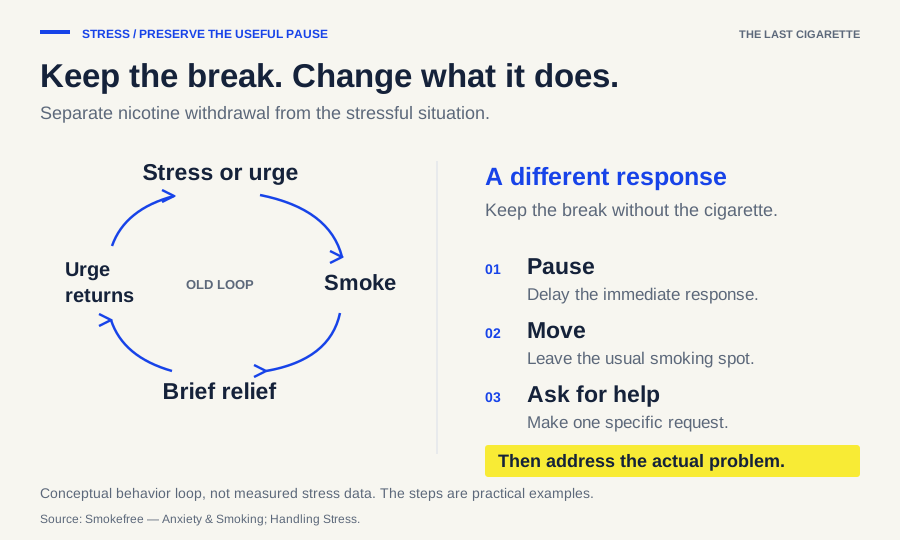
Smokefree explains that smoking can seem to ease anxiety because it temporarily relieves nicotine withdrawal. That relief does not resolve the situation causing the stress. Smokefree: anxiety and smoking
Separate the questions: “What can I do about the urge?” and “What needs doing about the problem?” You may need a brief change of scene for the first and an uncomfortable phone call for the second. A cigarette can feel like one answer to both while leaving the second untouched.
This distinction lets you keep the legitimate need for a break. You are allowed to pause without first lighting something.
Keep a real break in the schedule
If smoking was your only permission to stop working, removing it without replacing the pause makes the day harder than necessary. Schedule a short break at a time you used to smoke. Give it a location and an end.
You might walk to the other entrance, sit somewhere quiet with water or step outside away from the smoking area. Choose something available in your real circumstances. A parent at home may need a different plan from someone who can leave an office for ten minutes.
“After the afternoon meeting, I will leave my desk, walk downstairs and call my partner on the way back. I will return before opening the next task.”
Notice what the cigarette break used to provide: distance from people, fresh air, social company, a predictable ending or something to do with your hands. Preserve the useful part deliberately. You do not need to remove everything about the old ritual.
Use a small response while the feeling is strong
Smokefree suggests practical ways to manage stress and anxiety, including movement and relaxation. Choose a response that gives you room to make the next decision. Smokefree: handling stress
- Lower the immediate demand. Put down the phone for a moment before replying.
- Change the physical scene. Stand, stretch or walk somewhere that is not your smoking spot.
- Make a specific request. “Can you take this call while I have five minutes?”
- Name the next task. Solve the one thing in front of you rather than the whole day.
These are editorial examples of how to put a pause into practice. They do not make a serious problem disappear. Their purpose is to keep stress from automatically deciding that the next action is smoking.
After the strong feeling eases, return to the actual problem. Write the email, ask for the schedule change or decide what can wait.
Check the ordinary amplifiers
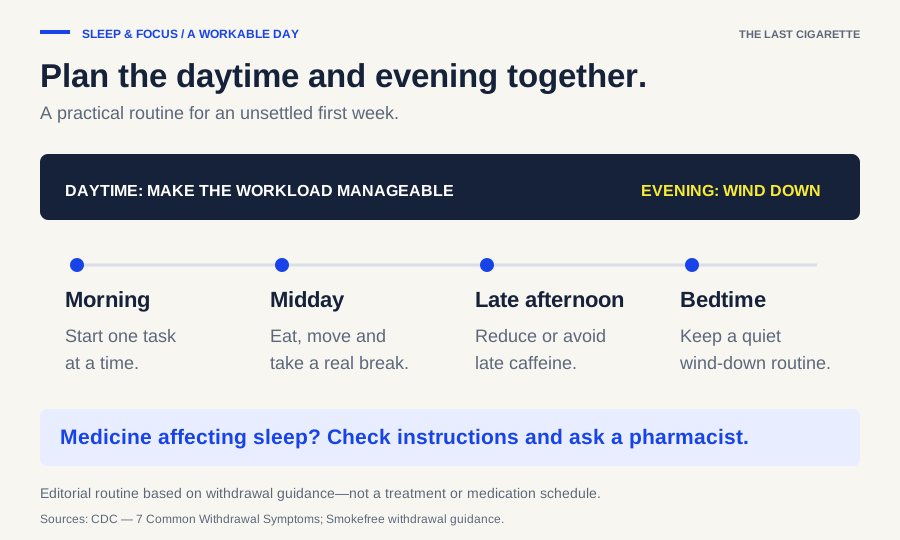
CDC lists restlessness, irritability, sleep trouble and difficulty concentrating among common withdrawal symptoms. It also notes that caffeine stays in the body longer after quitting. CDC: common withdrawal symptoms
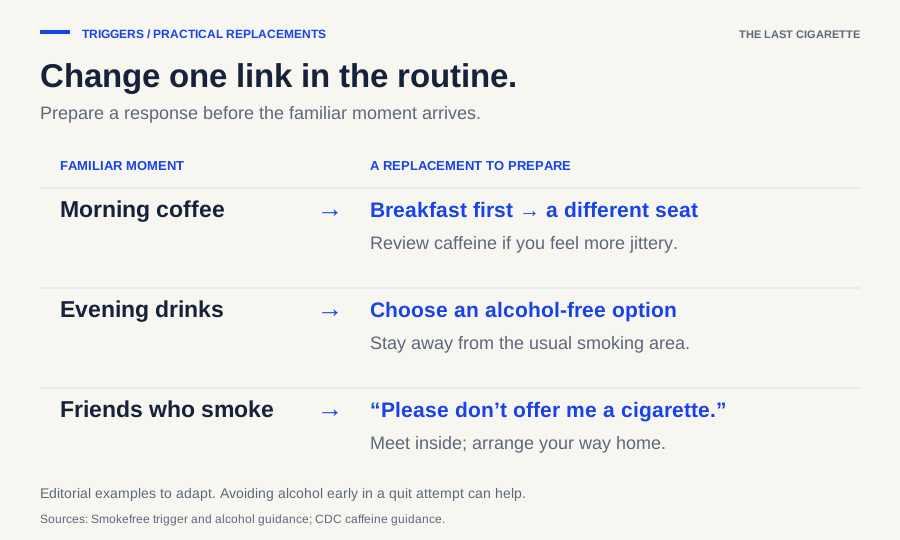
If you feel unusually wired, look at the coffee you are drinking before assuming you need a cigarette. If every evening ends badly, ask whether you are also hungry, underslept or trying to fit too much into the first week.
Keep a brief record for a few days: time, situation, caffeine, food, sleep and what helped. You are looking for a practical change, such as an earlier coffee cutoff or a meal before a difficult meeting. You do not need to assign a score to every emotion.
For the first week, avoid making every good habit a new project. A regular lunch and a manageable bedtime may be more useful than a demanding routine you cannot maintain.
What the evidence says about the longer view
Early discomfort does not establish that quitting will worsen your mental health in the long run. A 2021 Cochrane review found that stopping smoking was associated with improvements in several mental-health outcomes compared with continuing. The evidence varied in certainty, and much of it was observational, so this is an association rather than a promise for an individual. Cochrane: smoking cessation and mental health, 2021
That finding is useful because the first few days can be misleading. A difficult Tuesday is a reason to get support and adjust your plan. It is not strong evidence that cigarettes are the best long-term treatment for stress.
Continue existing mental-health care and tell your clinician you are quitting. If you take regular medicines, ask whether stopping smoking changes anything about their monitoring or use. Do not change prescribed treatment on your own.
Know when a coping tip is too small
If mood symptoms feel unmanageable or are not improving, contact a healthcare provider. CDC specifically recommends seeking help for difficult mood symptoms rather than assuming you must simply wait them out. CDC: mood symptoms after quitting
If you feel unsafe, seek urgent help. A breathing exercise or tracking tool is not an adequate response to an immediate crisis.
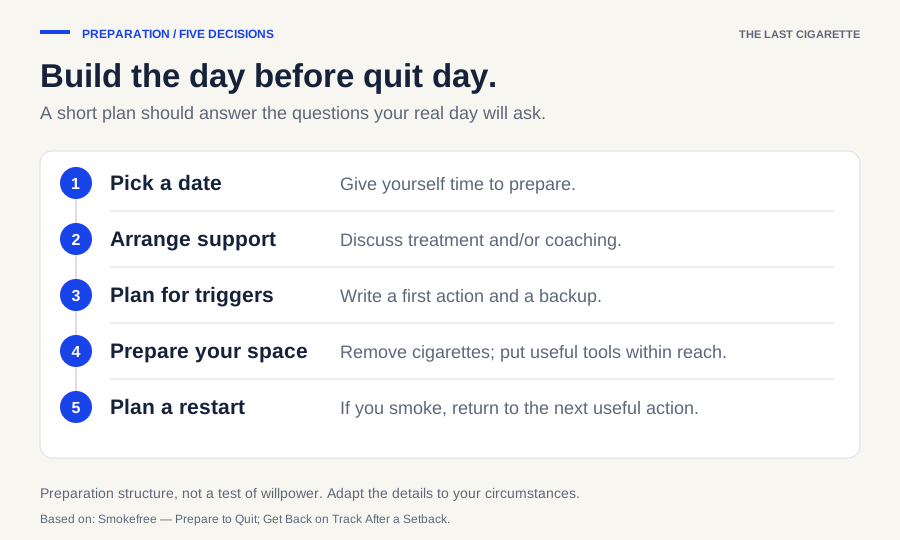
For everyday preparation, choose the next stressful situation you can foresee and write three lines: what will probably happen, how you will take a break and whom you can ask for help. Our quit-plan guide helps make that response concrete. If the pressure is mostly tied to an evening drink or a familiar group of friends, start with our guide to social triggers.
Sources & editorial notes
Published October 28, 2026. Linked public guidance and research checked on that date. Written by The Last Cigarette. Practical scenarios, illustrations and planning prompts are our editorial examples. Source dates below identify research publication, not a promise that an individual will follow an average.